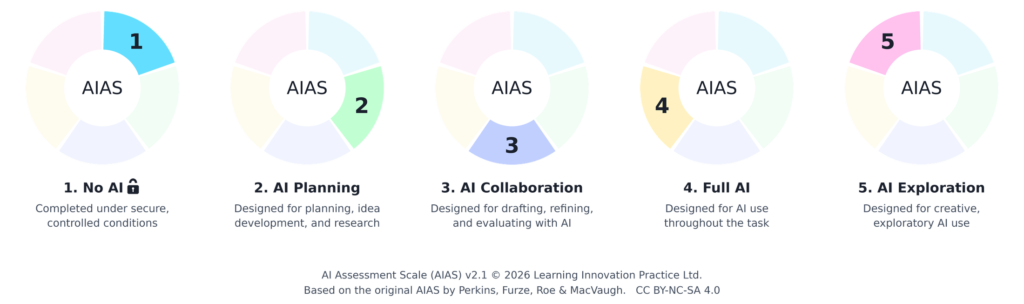
Navigating assessment authenticity in the age of AI is one of the most pressing challenges facing NZ teachers. As the Ministry of Education makes clear: ‘If generative AI is used to produce evidence that is assessed as the student’s work, then the assessment is invalid. The possible uses of generative AI in assessment contexts are therefore more limited than in teaching and learning contexts.’ The guidance below is grounded in 2026 NZQA assessment specifications and conditions of assessment for NCEA English Levels 1, 2, and 3. It draws on the AI Assessment Scale (AIAS) developed by Perkins, Furze, Roe and MacVaugh (aiassessmentscale.com) and the EAP-AIAS adaptation by Roe, Perkins and Tregubova (2024) for English language contexts. Teachers should always refer to the specific conditions for the standard being assessed and their school’s AI authenticity policy.
NZQA Assessment Traffic Light Guide
The tables below outline AI permissions for each NCEA English standard at Levels 1, 2, and 3, based on 2026 NZQA assessment specifications and conditions of assessment.
NCEA Level 1 English
| Standard | Title | Type | AI Guidance | Source |
| AS91924 | Demonstrate understanding of how context shapes verbal language use | Internal | 1: No AI permitted. All verbal analysis and ideas must be student’s own. | NZQA Level 1 Conditions |
| AS91925 | Demonstrate understanding of specific aspects of studied text | External | 1: No AI permitted in any external assessment. | NZQA AI Guidance |
| AS91926 | Develop ideas in writing using stylistic and written conventions | Internal | 1: No AI permitted. Ideas and writign must be entirely the student’s own. | NZQA Level 1 Conditions |
| AS91927 | Demonstrate understanding of significant aspects of unfamiliar written texts | External | 1: No AI permitted in any external assessment. | NZQA AI Guidance |
NCEA Level 2 English
| Standard | Title | Type | AI Guidance | Source |
| AS91098 | Analyse specified aspects of studied written text | External | 1: No AI permitted in any external assessment. | NZQA AI Guidance |
| AS91099 | Analyse specified aspects of studied visual or oral text | External | 1: No AI permitted in any external assessment. | NZQA AI Guidance |
| AS91100 | Demonstrate understanding of significant aspects of unfamiliar written texts | External | 1: No AI permitted in any external assessment. | NZQA AI Guidance |
| AS91101 | Produce a selection of crafted and controlled writing | Internal | 1: 2026 conditions explicitly prohibit generative AI or tools that automatically generate content. All writing and ideas must be the student’s own. | NZQA Level 2 2026 Assessment Materials |
| AS91102 | Construct and deliver a crafted and controlled oral text | Internal | 1: Ideas, language, and delivery choices are all assessed. No AI permitted for content or structure. | NZQA Level 2 2026 Assessment Materials |
| AS91103 | Create a crafted and controlled visual and verbal text | Internal | 1: Visual and verbal choices are assessed. No AI permitted for content creation. | NZQA Level 2 2026 Assessment Materials |
| AS91104 | Analyse significant connections across texts | Internal | 1: Analysis and connections must be the student’s own. No AI permitted. | NZQA Level 2 2026 Assessment Materials |
| AS91105 | Use information literacy skills to form developed conclusions | Internal | 2: AI may support finding and evaluating sources with full citation and critical discernment. Conclusions must be entirely the student’s own. Refer to your school’s AI authenticity policy. | NZQA Level 2 2026 Assessment Materials |
| AS91106 | Respond personally to independently read texts | Internal | 1: Personal response must be entirely the student’s own. No AI permitted. | NZQA Level 2 2026 Assessment Materials |
| AS91107 | Analyse aspects of visual or oral text through close viewing and listening | Internal | 1: Analysis must be the student’s own. No AI permitted. | NZQA Level 2 2026 Assessment Materials |
NCEA Level 3 English
| Standard | Title | Type | AI Guidance | Source |
| AS91472 | Respond critically to specified aspects of studied written text | External | 1: No AI permitted in any external assessment. | NZQA AI Guidance |
| AS91473 | Respond critically to specified aspects of studied visual or oral text | External | 1: No AI permitted in any external assessment. | NZQA AI Guidance |
| AS91474 | Respond critically to significant aspects of unfamiliar written texts | External | 1: No AI permitted in any external assessment. | NZQA AI Guidance |
| AS91475 | Produce a selection of fluent and coherent writing | Internal | 1: All writing and ideas must be the student’s own. No AI permitted. | NZQA Level 3 Conditions |
| AS91476 | Create and deliver a fluent and coherent oral text | Internal | 1: Ideas, language, and delivery are all assessed. No AI permitted. | NZQA Level 3 Conditions |
| AS91477 | Create a fluent and coherent visual text | Internal | 1: Visual and verbal choices are assessed. No AI permitted for content creation. | NZQA Level 3 Conditions |
| AS91478 | Respond critically to significant connections across texts | Internal | 1: Critical analysis and connections must be the student’s own. No AI permitted. | NZQA Level 3 Conditions |
| AS91479 | Develop an informed understanding of literature and language using critical texts | Internal | 2: AI may support finding and accessing critical texts with full citation. All analysis and argument must be the student’s own. Refer to your school’s AI authenticity policy. | NZQA Level 3 Conditions |
| AS91480 | Respond critically to significant aspects of visual and oral text through close reading | Internal | 1: Close reading and analysis must be the student’s own. No AI permitted. | NZQA Level 3 Conditions |
AI in Teaching and Learning (non-assessed contexts)
Outside formal assessment, AI offers rich opportunities for teaching and learning when used deliberately and critically. The examples below draw on the AI Assessment Scale (AIAS) by Perkins, Furze, Roe and MacVaugh to illustrate everyday classroom uses for NZ English teachers. Full implementation guidance at aiassessmentscale.com/implementation-guide.
| Classroom Activity | AIAS Level | Notes |
| In-class reading response or timed writing | 1: No AI | Students develop independent close reading and writing skills without assistance. Completed under teacher supervision. |
| Pre-reading vocabulary or context building | 2: AI Planning | Teacher uses AI to generate background context or vocabulary lists to support student comprehension before engaging with the text. |
| Brainstorming and idea generation for creative writing | 2: AI Planning | AI may generate initial ideas or prompts. All writing and development must be the student’s own. |
| Research and source-finding | 2: AI Planning | AI assists with identifying sources and structuring research questions. Students critically evaluate all sources and write their own conclusions. Cite all AI use. |
| Drafting with AI feedback | 3: AI Collaboration | AI gives feedback on a student draft. Students critically evaluate suggestions, make their own decisions, and reflect on what they changed and why. |
| Analysing AI-generated text as a class stimulus | 2: AI Planning | Teacher generates an example text for students to analyse, critique, and compare with human-written examples. |
| Research synthesis across multiple texts | 4: Full AI | AI assists with synthesising sources. Students critically evaluate, substantially revise, and reflect on AI outputs. All AI use cited. |
| AI literacy critical discussion | 5: AI Exploration | Students use AI tools extensively and critically, comparing outputs and reflecting on accuracy, tone, bias, and cultural assumptions. |
Designing AI-Resilient Assessments: A Checklist for Teachers
- Does the assessment measure a skill that would be undermined if a student used AI to complete it?
- Can the assessment be completed under controlled conditions, or does it need to be redesigned for an unsupervised context?
- Does the task require students to show their process, not just their final product? (e.g. drafts, checkpoints, reflections, verbal questioning)
- Have you communicated clearly to students which AIAS level applies and what that means in practice?
- Does the task design make the intended level of AI use obvious, not just stated in a label?
- Have you considered using verbal questioning or a follow-up conversation to verify student understanding?
- Is there an authenticity declaration students must sign before submission?
- Does the assessment connect to your school’s AI authenticity policy?
- Have you considered a sequence of assessments at different AIAS levels to build a fuller picture of student capability over time?
Adapted from NZQA authenticity guidance and the AI Assessment Scale implementation framework. See NZQA AI Guidance and aiassessmentscale.com for further detail.
NZ Resources & Guidance
- NZQA: Guidance on the acceptable use of AI in NCEA assessment
- Ministry of Education: Generative AI guidance for schools
- Ministry of Education: GenAI in NCEA Assessment FAQs
- ERO: Ready or Not – How are schools responding to AI?
- AI Assessment Scale – Implementation Guide
- Leon Furze: AIAS in Action – K-12 and Higher Education Examples
References
- Roe, J., Perkins, M., & Tregubova, Y. (2024). The EAP-AIAS: Adapting the AI Assessment Scale for English for Academic Purposes. TESOL Journal. https://doi.org/10.1002/tesj.70122
- Perkins, M., Furze, L., Roe, J., & MacVaugh, J. (2024). The Artificial Intelligence Assessment Scale (AIAS): A Framework for Ethical Integration of Generative AI in Educational Assessment. Journal of University Teaching and Learning Practice, 21(6). https://doi.org/10.53761/q3azde36
- Ministry of Education. (2025). Generative AI in NCEA Assessment: Frequently Asked Questions. New Zealand Government.
- ERO. (2026). Ready or Not: How are schools responding to artificial intelligence? Education Review Office, New Zealand.
The EAP-AIAS paper by Roe, Perkins and Tregubova (2024) is available to read in full on this page